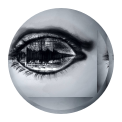

From Techno to Texture
Techno and texture meet at the moment when electronic music stops relying only on repetition. Techno and texture are not opposites. They are two different ways of organizing attention, movement, and sound.
Techno and texture are not enemies
Techno taught me concentration. Repetition can sharpen perception. It can clear space and make even a small sonic shift feel important. Yet repetition is not the only way electronic music can hold attention.
Texture works differently. It does not always push the body forward. Instead, it draws the ear inward. A low drone, a grainy surface, a fragile harmonic, or a hidden noise can carry more meaning than a strong pulse. As a result, listening becomes less about anticipation and more about presence.
Because of that, techno and texture belong to the same wider field. One organizes energy through pattern. The other organizes attention through detail.
From repetitive rhythm to deep listening
At a certain point, I no longer wanted rhythm to dominate every musical idea. I wanted electronic music without a fixed repetitive center. I wanted to hear timbre more clearly, to follow the inner life of sound, and to stay with small movements that would disappear in a louder structure.
So the focus shifted.
Instead of building everything around the beat, I became more interested in electroacoustic music, live electronics, experimental composition, and immersive listening. These forms allowed sound to breathe in another way. They opened space for tension without constant propulsion. They also made room for instability, silence, residue, and transformation.
Therefore, the move away from techno was not a rejection of electronic music. It was a move deeper into it.
Why texture matters in electronic music
Texture matters because it changes how time is felt.
A repetitive rhythm often tells you where the next moment will land. Texture does not always do that. It can suspend motion, blur direction, or make a single sound unfold in layers. Consequently, the listener is no longer waiting for the next drop, accent, or release. The listener starts hearing shape, density, and atmosphere as form.
This is where electronic music becomes more than genre. It becomes a way of perceiving.
A surface can become structure. A tone can become space. A noise can become memory. In this kind of work, sound is not decoration. Sound is the event itself.
Techno, texture, and the listener
Not everyone who arrives through techno wants to stay in the club frame forever. Some listeners begin searching for something slower, stranger, and more spacious. They still want electronic sound, but they want it without obligation. They want depth instead of function. They want immersion instead of command.
That search often leads toward ambient, electroacoustic music, experimental electronics, field recordings, and deep listening. It also leads toward works where pulse remains only as a trace, a shadow, or a distant reference.
This is the area that interests me most.
Where my work stands
My work moves between electronic music, sound compositions, and immersive listening. Sometimes rhythm is present. Sometimes it is almost gone. In both cases, the aim is the same: to let sound carry form through texture, space, pressure, and movement.
Listen beyond repetition
Techno and texture are not two separate worlds. They are two thresholds inside electronic music.
One leads through rhythm. The other leads through detail.
Sometimes the second begins exactly where the first seems to end.